Research Project / JSPS KAKENHI (A) / 2026–2030
Networked Security Cooperation
Empirical Analysis of Networked Security Cooperation: A Mixed-Methods Study of Policy Effects
Jaehwan Lim (PI), Yasuhiro Izumikawa, Tomohiko Satake, Koji Oishi, Amane Yamazaki, Ayumi Togashi, Tomoko Takahashi · KAKEN record ↗
01 The Dataset
Indo-Pacific Security Cooperation Dataset (ISCD)
A new dataset on defense and security cooperation in the Indo-Pacific since 2011, covering 30 core countries and major extra-regional powers. It extends Kinne’s Defense Cooperation Agreement Dataset (DCAD, 1980–2010) to the period after 2011.
Two dimensions
Formal agreements (formality) and standing mechanisms and regular exercises (regularity), capturing cooperation that agreement-only data miss.
Multiple layers
Bilateral, minilateral (3–6 countries), multilateral (7 or more), and meeting venues such as the Shangri-La Dialogue.
Source tracking
Each entry records the country of its source and the level of evidence, to measure and correct for observation bias.
Beyond defense ministries
Joint diplomatic–defense mechanisms and law-enforcement cooperation, so China and the United States can be compared on the same scale.
Status (November 2026): about 52,000 source entries, consolidated into a master table of 2,961 agreements and standing mechanisms. Manual validation against original sources is the next step.
02 Preliminary Results
A more multipolar network
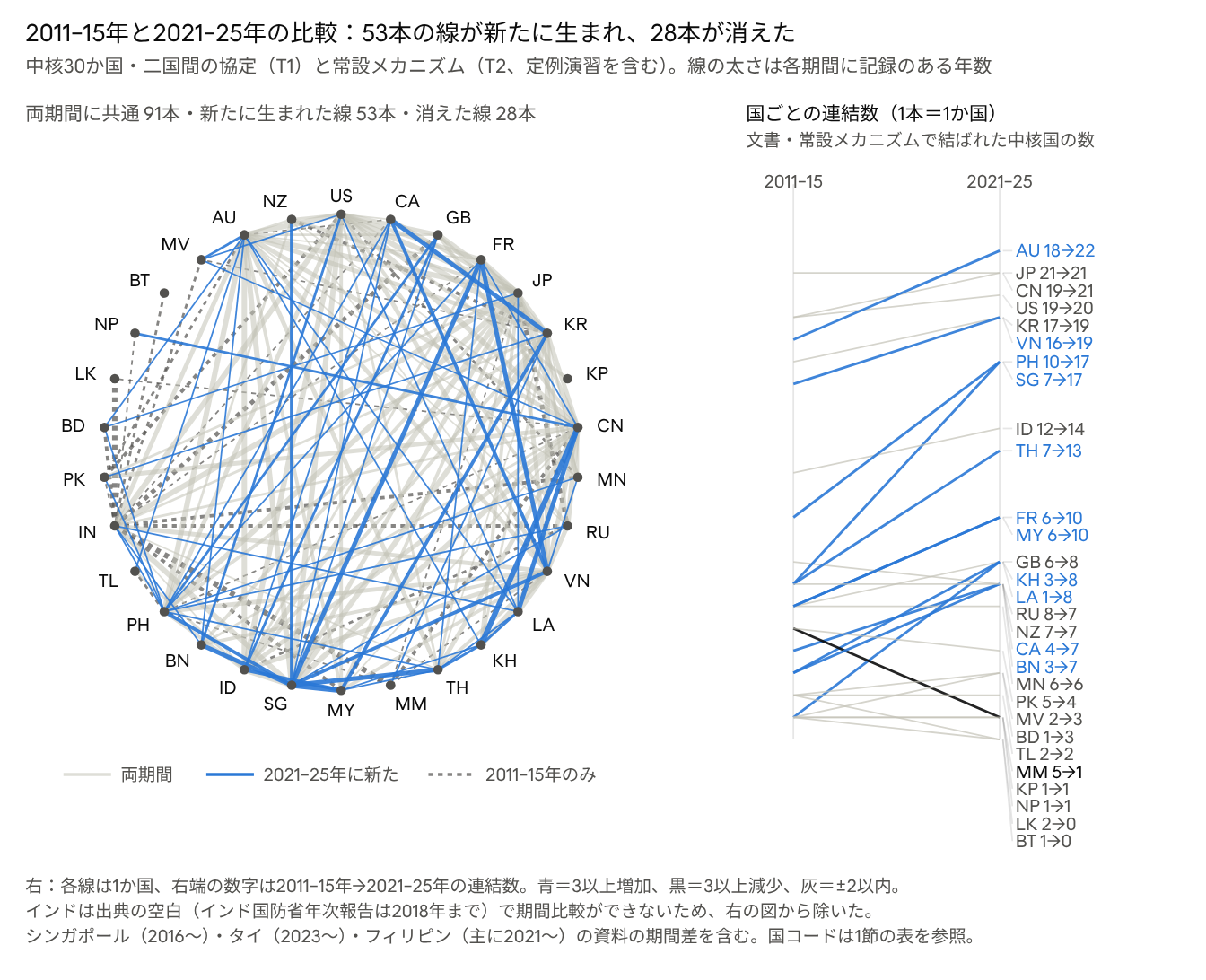
Across 2011–15, 2016–20 and 2021–25, the bilateral network of agreements and standing mechanisms among the 30 core countries grows from 125 to 147 to 161 ties, and becomes denser and more multipolar. Between the first and last periods, 102 ties persist, 59 are new, and 23 disappear. By 2021–25 the center is shared by India, Australia, Japan, China, the United States, Vietnam, South Korea, Singapore and the Philippines.
Preliminary (updated November 21, 2026): based on automatically extracted data not yet validated against original sources; observed structures may partly reflect differences in source coverage. Click a figure to enlarge.
Formality and regularity: a U.S. lattice and a Chinese regularized hub
Splitting institutionalization into formality (agreements) and regularity (standing mechanisms and regular exercises) reveals two different architectures. On the formality axis, U.S. partners increasingly tie to each other directly (ego-network density 0.36 → 0.59) and U.S. betweenness halves (0.21 → 0.10). On the regularity axis, the number of U.S. partners with regular consultations or exercises rises from 13 to 19, and U.S. betweenness recovers (0.04 → 0.14). Allies weave the formal lattice; the United States stays central by widening its regular ties.
China, by contrast, expands a hub-and-spoke web on the regularity axis: its partners remain weakly connected to each other (density 0.35 → 0.42) while China’s brokerage position rises. Within the core 30, however, there is no exclusive sphere: in 2021–25, 84% of U.S. partners are also tied to China, and 80% of China’s partners to the United States.
Japan and South Korea
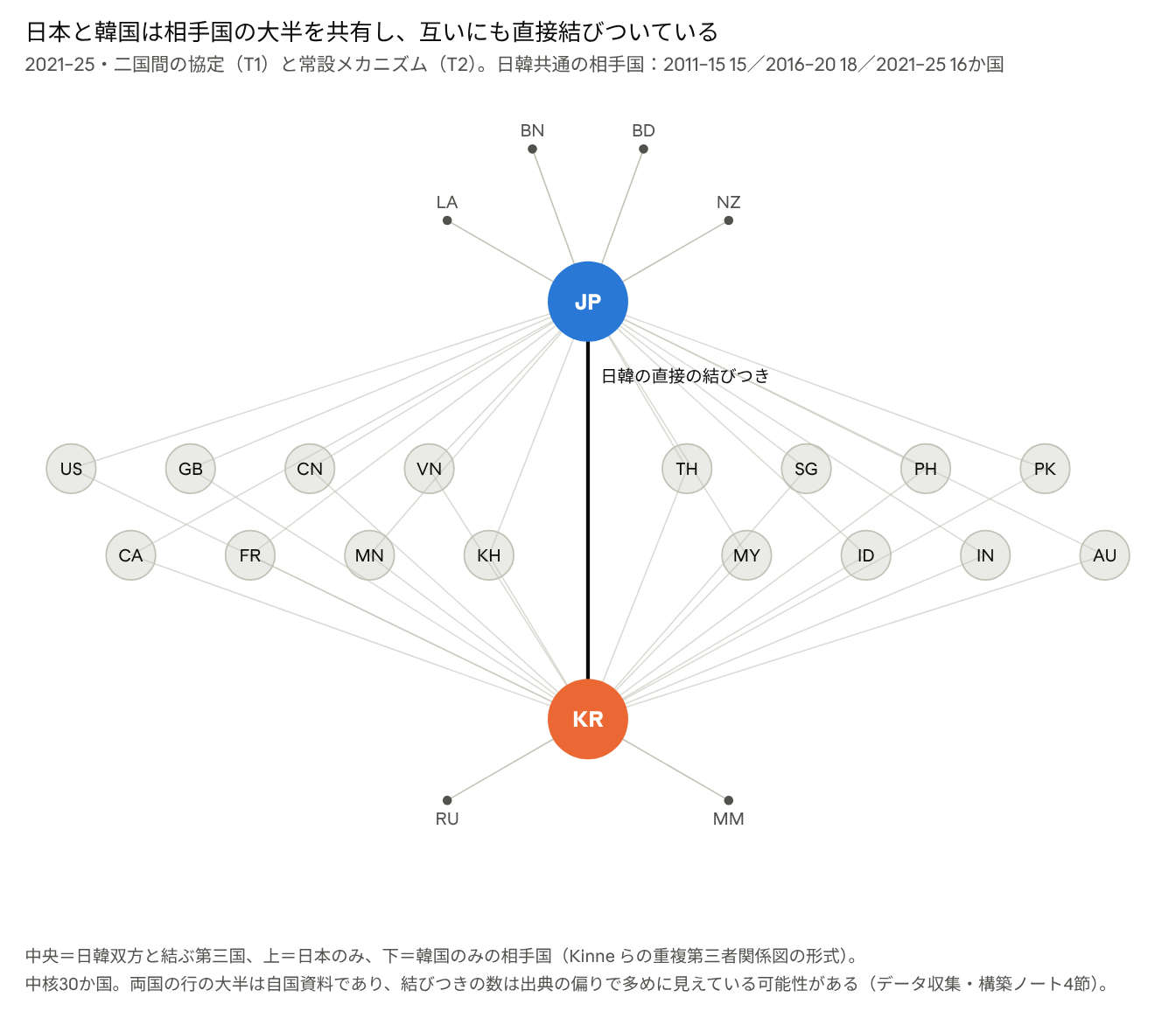
Both are stable hubs whose positions barely change across the three periods, and they share most of their partners (16 → 20 → 16 countries). The difference lies in the form of engagement: Japan diversifies rapidly into minilateral formats (active groupings 12 → 37 → 92), while South Korea’s minilateral engagement is concentrated in the U.S.–Japan–ROK trilateral.
Figure 3. Japan’s and South Korea’s ties in the 2021–25 network.
03 Fieldwork
Research trips
November 17–18, 2026
Seoul, South Korea
Research meetings with the National Assembly Research Service, Ewha Womans University, Korea National Diplomatic Academy, Sejong Institute, and Korea Institute for Defense Analyses (KIDA).

